
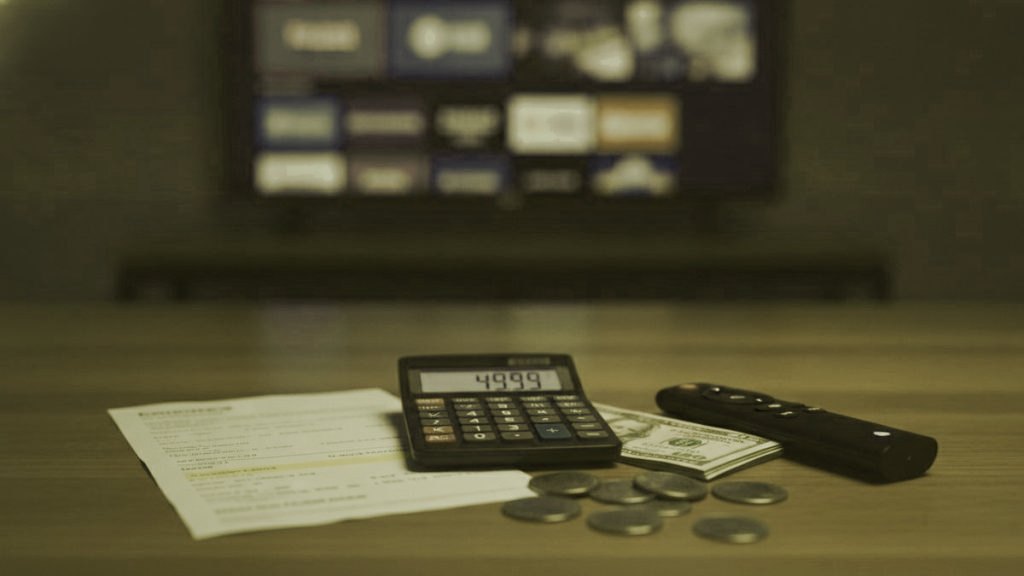
An IPTV subscription costs somewhere between twelve and twenty-five dollars a month almost everywhere, and a provider quoting far outside that range is telling you something about itself rather than offering a bargain. What is worth understanding is not the number but the structure underneath it: which costs are fixed, which scale with subscribers, and consequently what has to be cut when somebody sells a year for twenty dollars.
The short version
One screen: $15 a month or $69 a year. Each additional simultaneous screen adds roughly $10 monthly and considerably less annually. Below about $12 a month something is being cut, and the first thing cut is staffing — the person who answers when your stream breaks on a Sunday.
The published arithmetic
A single screen is $15 for one month, $29 for three, $45 for six and $69 for twelve — $5.75 a month if you take the year. Two screens run $25, $49, $75 and $119 across the same terms; three screens $35, $65, $99 and $159; five screens $49, $99, $149 and $239. Every tier carries identical channels, an identical catalogue and identical 4K feeds. Nothing improves as you move up except how many people watch at once.
The annual saving is substantial — roughly sixty percent off the monthly rate — and the cost of each extra screen falls sharply on longer terms. A five-screen year at $239 works out at $19.92 a month against $49 monthly.
Where the money actually goes
Three recurring costs, and only one of them scales the way people assume. Bandwidth scales directly with concurrent viewers: it is not a fixed cost thinning out as you sell more, it grows with every stream playing. Server capacity has to be provisioned for peak rather than average, so you pay year-round for headroom used on Saturday evenings. Staffing is the third, and it is the only one a provider can quietly remove without the website changing at all.
That last point is the whole argument of this article. If margins are impossible, capacity gets thinner — which shows up as evening collapse and is at least visible. Or the desk gets thinner, which shows up as nothing whatsoever until the night you need it, and then shows up as silence. A landing page cannot distinguish a provider with people from one without, and that is precisely why we suggest testing the desk before paying.
What the floor implies
A year sold for twenty dollars is not a better deal on the same product. It is a different product with something removed. Either capacity has been under-bought against the subscriber count, or nobody is being paid to answer messages, or the operation does not expect to be serving those subscribers in twelve months. Occasionally all three.
None of that is a moral point. It is an arithmetic one: bandwidth and people cost what they cost, and a price below the floor means somebody has decided which of them to stop buying.
Costs outside the subscription
Hardware, sometimes. Most households already own something that works, and a provider worth buying from will tell you before you spend rather than after. Where a television is too old, a Fire TV Stick at thirty to fifty dollars is usually the end of it. Formuler and MAG boxes at $120 to $180 earn their place on a main television watched daily and are poor value anywhere else.
Apps, occasionally. TiViMate Premium is about $9.99 a year and worth it for whoever watches sport. Smart IPTV charges a one-off activation per television, which matters in a house with several sets since it is charged per set. IPTV Smarters costs nothing anywhere, which is why it is the default recommendation here.
Bandwidth, indirectly. If your connection cannot carry the screens you intend — roughly 10 Mbps per HD stream, 25 per 4K one — then a subscription is not what needs upgrading. Establish that during a trial rather than discovering it in week two, because no provider can fix a line that was never fast enough.
Against what you currently pay
Do the comparison properly rather than against a single streaming subscription, which flatters us. Add the live-TV service, any sports pass, and each catalogue platform. Most households find a total higher than expected, because it accumulated one decision at a time over several years.
Then be equally honest about what this displaces. The live half — channels, sport, news, national broadcasters — is genuinely additive and largely not sold by the platforms. The catalogue overlaps theirs substantially. The originals they commission are absent and always will be. If one specific programme is why somebody in your house pays for a service, that bill stays and the arithmetic should include it staying.
Term length, honestly
Take a month first. It costs about fifty-four dollars more across a year and buys the ability to walk away cheaply if your connection, devices or habits turn out not to suit this. Buy the year once two busy weekends have told you it works — the saving does not expire in four weeks.
And when a term ends here, a reminder arrives and you decide. Nothing renews by itself and no card is stored, which is deliberate: automatic renewal at an introductory rate that silently becomes a standard rate is the commonest way an entertainment budget grows without anybody choosing it.
A worked example
Take a household paying roughly $75 a month for a live-TV service, $20 for a sports pass and $15 each for two catalogue platforms — about $125 monthly, accumulated one decision at a time over several years. Suppose the trial shows that two simultaneous screens cover their evenings.
Two screens for a year is $119, or about $9.92 a month. If that displaces the live service and the sports pass, the household moves from $125 to roughly $40. If one catalogue platform also goes unopened, closer to $25. If neither platform goes — because somebody watches one specific series — it is $40, which is still a substantial change. The point is not the largest number the arithmetic can produce but the honest one, and the honest one depends entirely on which lines your household actually stops using.
What renewal should look like
Nothing here renews by itself and no card is stored, which is deliberate rather than an oversight. Automatic renewal at an introductory rate that silently becomes a standard rate is the commonest mechanism by which an entertainment budget grows without anybody deciding it should — and a fair number of people arriving at this site are arriving because that happened elsewhere.
The practical consequence is that a reminder arrives when a term ends and you decide. It also makes renewal the natural moment to reconsider the tier. Households that bought three screens and used two should say so; the next term is then priced at two. Keeping a customer at a lower figure is a better outcome than holding them to a number they chose before they had any evidence.
The cost nobody puts on the page
Your own time. A service that works is nearly free to run — a few minutes of setup and then nothing. A service that half-works is expensive in a way no price list captures: evenings spent changing settings, messages that go unanswered, the household asking why the television is broken again.
That is the real argument for paying above the floor rather than below it, and it is why we would rather sell a month than a year to somebody uncertain. Twelve dollars saved against forty minutes lost every fortnight is a poor trade, and it is the trade the cheapest services in this market are quietly offering.
Frequently asked questions
What does it cost per month?
One screen is $15 monthly or $69 for a year, near $5.75 a month. Two screens are $25 and $119 on the same terms. The tiers differ only in simultaneous playback — channels, catalogue and quality are identical across all of them.
Why is there a price floor?
Because bandwidth scales with concurrent viewers, capacity must be provisioned for peak rather than average, and people have to be paid to answer at night. Below roughly twelve dollars a month one of those three is being cut, and the invisible one is staffing.
Are there hidden fees?
None here. Nothing renews automatically, no card is stored, and there is no setup charge. The costs outside the subscription are third-party: hardware if you need it, and TiViMate Premium or Smart IPTV's activation if you choose those apps.
Monthly or yearly on a first purchase?
Monthly, against our own interest. The annual saving is real but so is the risk that your connection turns out to be the limitation. Spend a month finding out, then commit — the saving is still available in four weeks.
Can I change tier partway through?
Upward at any time, charged at the difference for the remaining period rather than restarting the term, and your credentials keep working throughout. Downward happens at renewal, and a fair number of households do exactly that after a first term.
What happens when a plan ends?
A reminder arrives and nothing happens unless you reply. No card is stored, so there is nothing to cancel and nothing that can renew by itself. The line simply stops at the end of the period you paid for.
Why not offer an introductory rate?
Because an introductory rate that later becomes a standard rate is the commonest way a household bill grows without anybody choosing it, and a good proportion of people arriving here are arriving because that happened somewhere else.
Ready to watch 25,000+ channels?
Order on WhatsApp and get your login in under 15 minutes. 7-day money-back guarantee.
Related articles
Which IPTV Box to Buy, and Which Ones Generate Calls
The best IPTV box for most people is the one already plugged in. Where new hardware helps, which to buy, and which…
September 4, 2026Which IPTV Player to Use, Judged by What Goes Wrong
Every IPTV player has the same feature list. What separates them is what goes wrong with each, how confusing the failure is,…
August 31, 2026Is IPTV Legal? What a Buyer Should Actually Know
The technology is unambiguously legal. Whether a particular provider holds the rights to what it carries is a separate commercial question —…